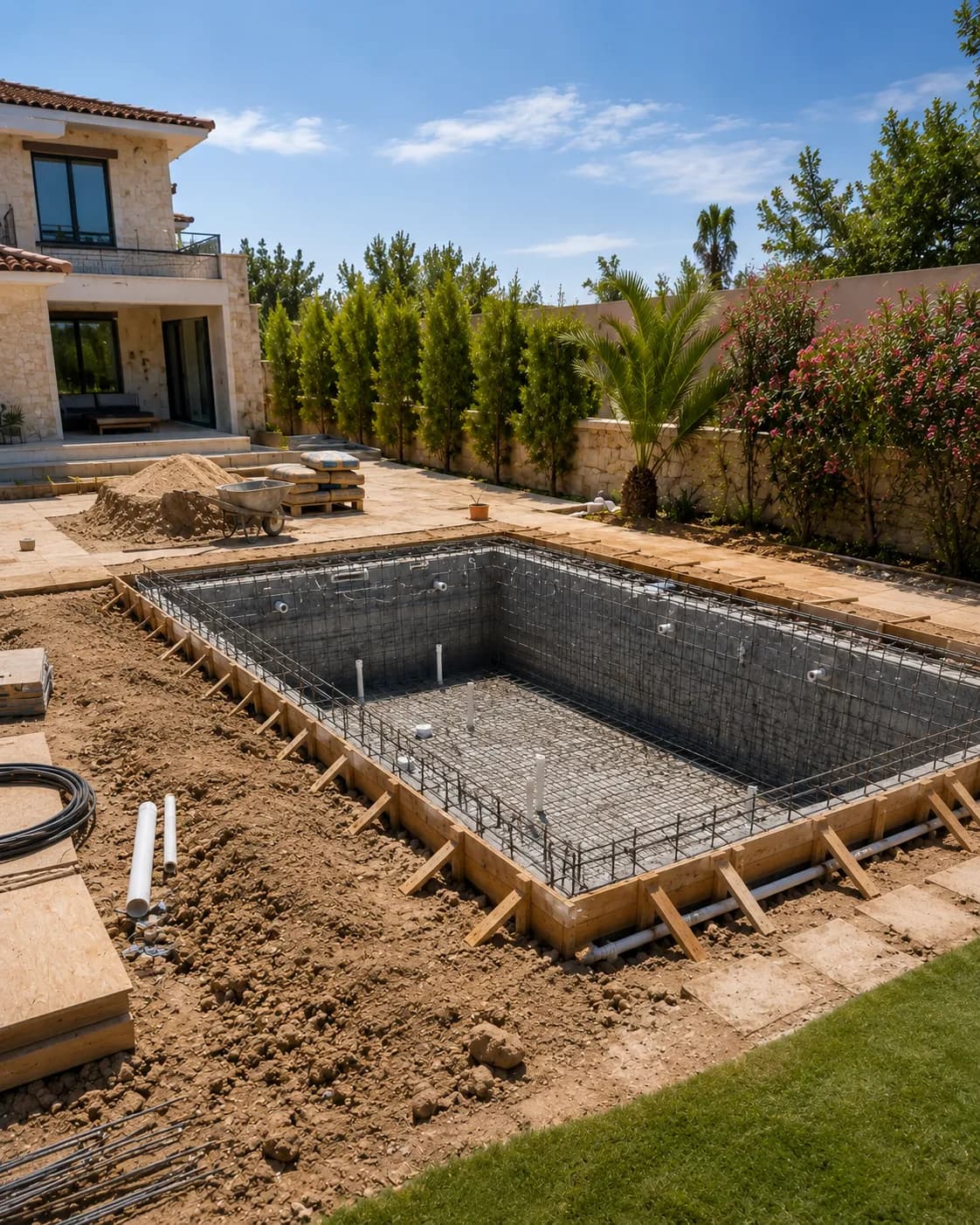
Prefabricated or Concrete Pool: How to Choose
A prefabricated pool has a body made in a factory and assembled on site; it is finished sooner and usually costs less up front. A reinforced-concrete pool is built in place, so it fits any size, shape or plot, and its finish can be renewed years later. In a flat garden with a standard-size pool, prefabricated may be enough; on a slope, with an overflow system or a custom design, concrete is the better fit.
What is a prefabricated pool?
A prefabricated pool is any pool whose structural body is made in a factory and installed quickly on site. There are two main kinds. In panel pools, steel or polymer panels are joined together on a prepared concrete base, and the watertight layer is usually a PVC liner fitted inside. In one-piece pools, a ready-made shell is lowered into the excavation by crane; fibreglass is the best-known example, and we cover it separately in our fibreglass versus concrete pool comparison.
In both kinds, size and shape are limited to the manufacturer's range. The speed comes from most of the work being finished at the factory; excavation, ground preparation, plumbing and the surrounding paving still happen on site.
How is a reinforced-concrete pool built?
A reinforced-concrete pool is made entirely on site: after excavation, steel reinforcement is tied and concrete is either poured into formwork or sprayed (gunite). Once the shell is complete it is waterproofed, and then a finish such as ceramic tile or glass mosaic goes on. That sequence takes time, because the concrete has to cure and each layer must go on at the right moment. A standard villa pool is usually completed within 8 to 14 weeks of design approval. In return, the size, depth, steps and overflow type are decided by the plot rather than by a catalogue. We go through the items that make up the budget in our article on pool construction costs.
Prefabricated and concrete pools: a comparison summary
Setting the two systems side by side under the same headings shows the difference most clearly. The summary below is general; the outcome for your pool depends on the plot, the ground and the product chosen.
| Feature | Prefabricated pool | Reinforced-concrete pool |
|---|---|---|
| Build time | Shorter | Longer, because of curing and finishing |
| Upfront cost | Usually lower | Depends on design, size and finish |
| Shape and size | Limited to the manufacturer's range | Any shape and depth |
| Interior surface | Liner or factory finish | Ceramic, porcelain or glass mosaic |
| Overflow system | Mostly skimmer | Skimmer, deck-level or infinity edge |
| Sloping plot | Needs flat, compacted ground | Structure is engineered for the site |
| Repair | Liner is replaced; few options if the body is damaged | Finish and waterproofing can be renewed |
Which is better on a sloping plot?
On a sloping plot, a reinforced-concrete pool is the better choice. Many parcels in Çeşme and Alaçatı are rocky and sloped; on that kind of ground the pool shell often works together with a retaining wall, and the structure has to be engineered for the site. A ready-made shell or a panel system, by contrast, needs flat, compacted ground that supports it evenly on every side. A one-piece shell also has to reach the garden by lorry and crane, which is not always possible in neighbourhoods with narrow lanes. If you have a view-facing overflow edge in mind, our infinity pool article explains how that system works and why it is usually built in concrete.
Maintenance, repair and lifespan
Day-to-day care is the same for both: water balance, filtration and surface cleaning. The difference shows over the long term. In a liner pool, sharp objects, the wrong brush and water left unbalanced for long periods wear the surface, and a worn liner is replaced as a whole. Steel panels depend on their corrosion protection, and salty sea air makes that matter more on the coast. In a concrete pool, what wears is usually the finish and the grout; as long as the shell is sound, the pool can be renewed with a new finish. No single figure fits the life of a prefabricated pool; it depends on product quality, ground preparation, water chemistry and regular maintenance.
In short: which one suits you
If you have a flat, easily accessible garden, want a pool in a standard size and are working to a short timeline, a prefabricated system is a reasonable choice. If your plot slopes, if you want the size and shape to follow the architecture of the house, or if you are looking for an overflow system or a shell that can be renewed in the long run, concrete is the right route. At Seçkin Havuzculuk we work with gunite and reinforced concrete around Çeşme, Alaçatı and İzmir, and a site visit is the best way to see which solution your plot calls for. The steps of the process are set out on our pool construction page.
Common questions.
How long does a prefabricated pool last?
No single figure would be accurate. Its life depends on the material of the panels or shell, the corrosion protection, the quality of the ground preparation, balanced water chemistry and regular maintenance. The liner wears before the body does and is replaced when the time comes.
Is a prefabricated pool cheaper than a concrete one?
The upfront cost is usually lower, because the body is a standard product and there is less work on site. Excavation, ground preparation, plumbing and the surroundings are priced separately in both systems. For a fair comparison, make sure both quotes cover the same items.
Can a prefabricated pool be installed on a sloping plot?
It can, but the ground has to be levelled first and a base prepared that supports the body on every side. When that preparation calls for a retaining wall, the time and cost advantage of a prefabricated system shrinks. On clearly sloping parcels, concrete is usually the sounder solution.