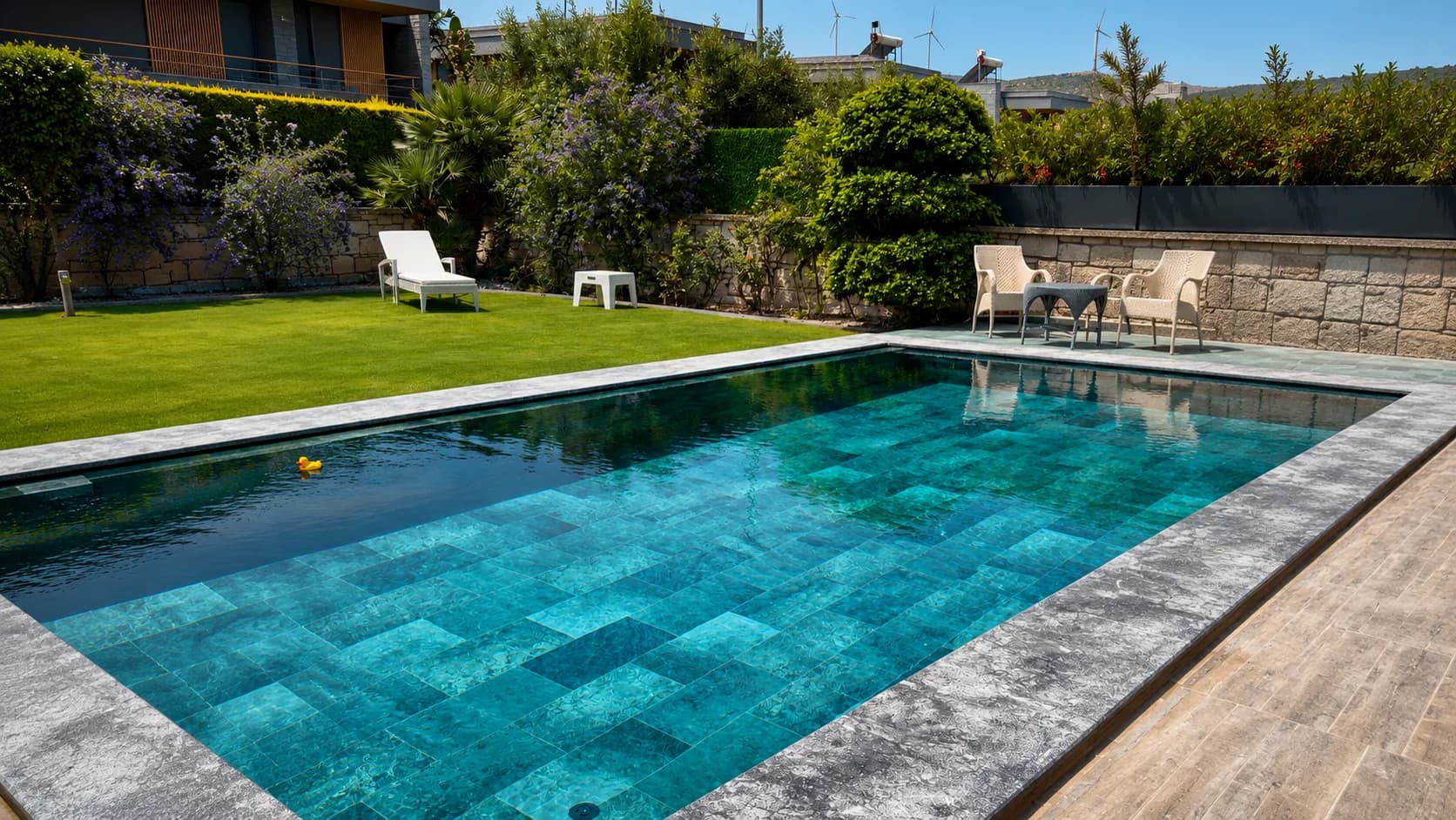
Overflow, Skimmer and Hidden-Weir Pools Compared
The three systems differ in how surface water leaves the pool. In a skimmer pool, water is drawn in through openings in the wall and the level sits a little below the edge. In an overflow pool the water is flush with the edge and spills into a channel around it; in a hidden-weir pool that channel is tucked under the coping, so no grating shows.
How does a skimmer pool work?
A skimmer pool collects surface water through skimmers, suction openings set into the pool wall. The pump draws water from these and from the main drain, passes it through the filter and sends it back through the return inlets. Because the water level is held at the middle of the skimmer mouth, a visible band of wall remains between the coping and the water. The system needs no balance tank, its plumbing is simpler and its upfront cost is lower. Its weak point is surface cleaning: leaves and dust only drift towards the spots where the skimmers are, so they should be placed with the prevailing wind in mind.
What is an overflow pool?
In an overflow pool the water sits level with the edge and spills into a channel around the perimeter. It is also called a deck-level pool. The water drops through a grated channel into a balance tank; the pump takes it from there, runs it through the filter and returns it to the pool. Debris is skimmed off along every edge all the time, so the surface stays cleaner and the pool reads as one plane with the paving. In exchange you need a balance tank, a larger plant room and precise levelling of the edge. The 4×8 metre deck-level villa pool we built in Alaçatı is one example. Pools where water falls over a single, view-facing edge are covered in our infinity pool article.
What does a hidden-weir pool mean?
A hidden-weir pool is an overflow pool whose channel is concealed beneath the coping instead of under a visible grating. The water still sits at edge level, but in most designs it runs into the channel through a narrow gap beside the coping stone, so all you see from outside is stone and water. It works on the same principle as a deck-level pool: channel, balance tank and return line. The difference lies in the look and the detailing. With the channel out of sight, cleaning access has to be planned at the design stage. We used this system when renovating a 4×8 metre pool in Ilıca; the details are in our hidden-weir renovation project.
The three systems at a glance
The summary below compares the three systems under the same headings. Because the cost difference varies by project, it is given as a direction rather than a figure.
| Feature | Skimmer | Overflow (deck-level) | Hidden weir |
|---|---|---|---|
| Water level | A little below the edge | Flush with the edge | Flush with the edge |
| Where water is collected | Skimmers in the wall | Grated perimeter channel | Channel under the coping |
| Balance tank | Not needed | Required | Required |
| Surface cleaning | At set points | Along the whole edge | Along the whole edge |
| Look | A band of wall above the water | A grating at the edge | Only stone and water |
| Upfront cost | Lowest | Higher | Higher, with more detailed workmanship |
| Plant room | Smaller | Larger, because of the tank | Larger, because of the tank |
How the maintenance routine differs
Water chemistry is managed by the same rules in all three; what changes is where the mechanical cleaning happens. In a skimmer pool the baskets are emptied often, because a blocked basket cuts the flow. In an overflow pool the channel and gratings replace the basket: leaves and sediment in the channel are cleared regularly and the balance-tank level is monitored. With a hidden weir the channel is not visible, so this check must not be skipped. An overflow surface is more exposed to wind; on very windy days evaporation and water loss can rise, so automatic top-up is common. The full weekly routine is set out in our article on how to maintain a pool.
In short: which one suits you
If you want to keep the budget simple and the pool is small or medium-sized, a skimmer system does the job. If you want the water flush with the deck, a cleaner surface and a wet-deck area, an overflow system is the fit. If you want the same function without a grating and with a quieter look, the hidden weir is the right choice. Changing the system on an existing pool is also possible; in our tundra grey renovation in Çeşme the pool was converted to deck-level overflow. At Seçkin Havuzculuk we make this decision during the site visit, around Çeşme, Alaçatı and İzmir, by looking at the plot and the space available for a plant room. The whole process is described on our pool construction page.
Common questions.
Is a hidden-weir pool the same as an infinity pool?
No. With a hidden weir, the water spills into a channel concealed under the coping, and the pool sits flush with the deck. In an infinity pool, the water falls over the view-facing edge into a channel below, so that it appears to merge with the horizon. The two can be combined in one pool.
Can a skimmer pool be converted to overflow later?
It can, but it is a renovation job: the edge structure changes, an overflow channel and a balance tank are added, and the plumbing is rearranged. Whether the plant room has enough space is checked beforehand. The decision is made once the pool has been seen on site.
Does an overflow pool use more water?
Water that spills over is not lost; it drops into the balance tank and returns to the pool through the filter. Losses are limited to evaporation and splash-out. Because the surface sits at edge level, that loss can be slightly higher on windy days than in a skimmer pool.